Every review of the Dremel 4300 reads like a victory lap. More than nine thousand ratings, a 4.7 average, and a chorus that it is the rotary tool to buy if you are only going to buy one. I am not going to argue with that verdict, because it is mostly right. But I have had the 4300-5/40 kit on my bench for a year of actual use, sharpening mower blades, opening drywall, polishing brass, cutting through a rusted bolt, and engraving a pair of anniversary wine glasses for my wife, and the marketing photos leave out a real set of small annoyances that determine whether this tool earns its place or gathers dust.
I am Ed Callahan, and I buy tools the way I buy anything else on my property: I weigh them against the labor they save and ask whether they will still work in five years. So this is not a hype review. This is the honest report on where the 4300 shines, where it fights you a little, and which of the forty included accessories are worth a place in your drawer. The tool genuinely deserves most of its reputation. It also has a collet wrench nobody told you about, the one you reach for the moment you switch shank sizes, a little runout that shows up at high speed, and an LED that sounds better on paper than it looks in a dark cabinet. Let me walk you through all of it.
The Quick Verdict
A genuinely excellent corded rotary tool that earns its reputation, held back from a perfect score only by a fiddly collet system, a bit of high-speed runout, and a kit full of accessories most people will never open.
Amazon Check Today's Price →The Rotary Tool That Handles Almost Every Shop Task
If you want the 4300 with the 5 attachments and 40 accessories, the current price is easy to find on Amazon. See today's price before you decide.
Amazon Check Today's Price on Amazon →How I've Used It
The 4300 is a corded variable-speed rotary tool that sits between the small Dremels and the heavy-duty models. It spins anywhere from 5,000 to 35,000 RPM, which is a wide enough band to sand wood slowly and cut through steel fast. I bought it specifically to replace an older corded model that had lost its nerve after fifteen years, and I have used it steadily since: maybe two or three evenings a month, plus the occasional full weekend on a bigger job.
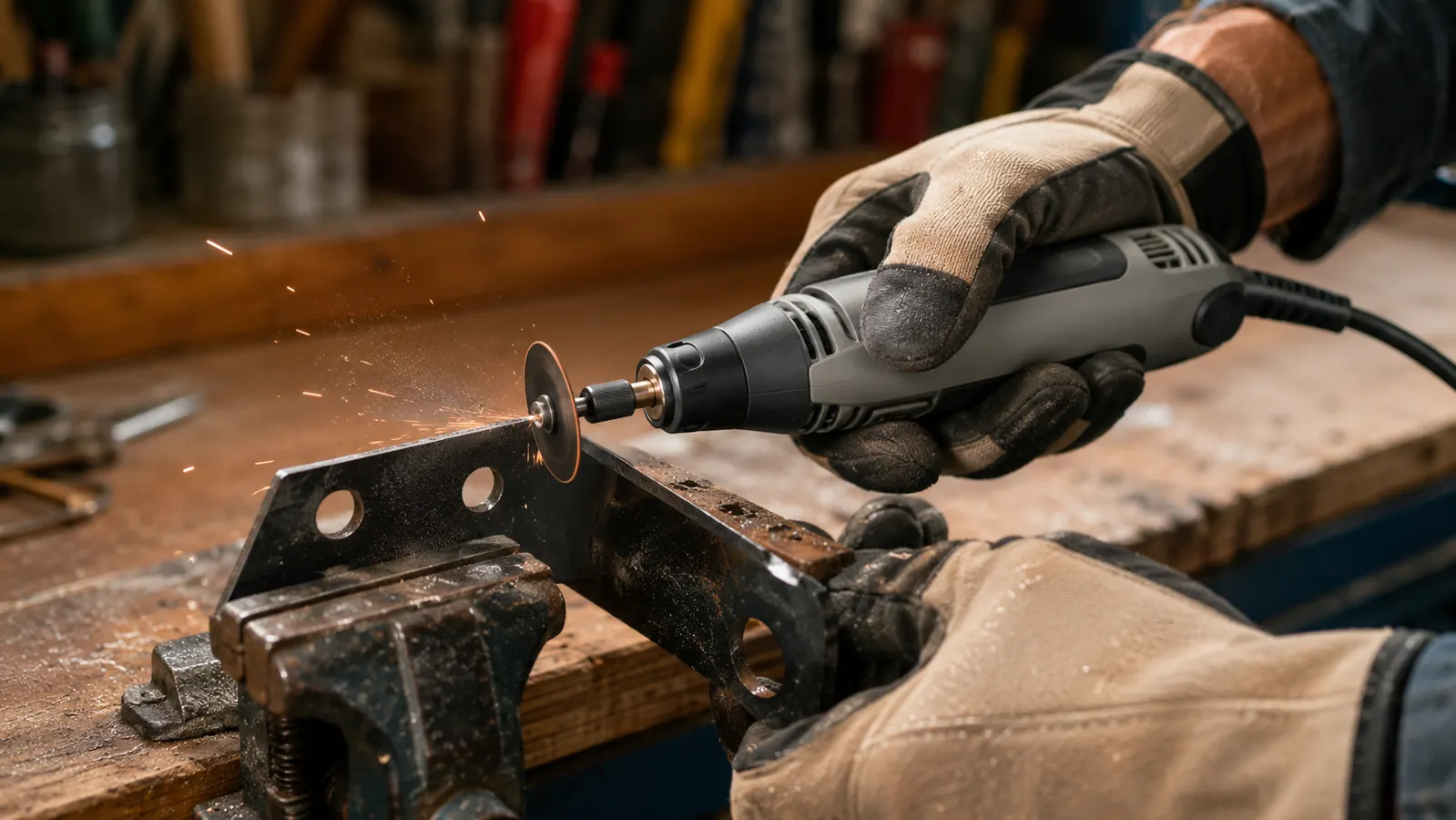
My rough count over the year: I sharpened four lawn mower blades and a set of grass shears, cut a dozen or so holes in drywall for outlet boxes, polished the brass fittings on my front door back to a mirror finish, cut through a seized carriage bolt on a rental fence gate that had me ready to call a pro, engraved two sets of glassware, and opened a stuck paint can the modern way by cutting a clean groove into the rim. That is a broad spread, and honestly that breadth is the whole argument for owning a rotary tool at all. No other single tool in my shop does all of those jobs.
I will say this plainly, because it matters: the 4300 is not magic, and it is not a miracle worker. It is a very good corded rotary tool that takes the right bit, the right speed, and a patient hand. The marketing makes it look like you clamp on a disc and walk away. In practice it rewards practice the way any good hand tool does. Keep that expectation and you will be happy with it. Expect it to think for you and you will be disappointed no matter how good the tool is.
The Collet System Will Test Your Patience
Here is the friction point nobody puts in the listing photos. For an ordinary bit swap the 4300 does what the box promises: you push the small button, pinch the EZ Twist nose cap, and the bit comes free by hand, with no separate wrench anywhere in the process. That part is a real improvement over digging a chuck key out of the case every time. The catch is the collets themselves. A rotary tool bit only fits the collet that matches its shank, so the moment you move between shank sizes you are threading a different collet in, and that is when the thin stamped wrench comes out of the accessory case.
And that wrench is a problem wrapped in a convenience. It is a thin stamped metal tool, and the 4300 does not have a built-in storage slot for it. Dremel expects you to keep it clipped to the cord or in the accessory case, which sounds fine until you are up on a stepladder boring a hole in a ceiling and realize the wrench is back at the bench. I have lost track of that wrench three times in a year, and relocating it always costs me a trip across the shop. Pick up a spare or two when you buy the tool, because losing that single little piece stops everything.
There is also a learning curve to seating bits straight. With a thin bit, thread the collet nut down and you can seat it slightly crooked without realizing it, which shows up as a wobble once you spin up to speed. The fix is simple once you know it: snug the bit, hand-tighten the nose cap, spin the tool briefly by hand to check it runs true, then seat the cap firmly. After the first month that becomes automatic. Before you learn it, you will occasionally wonder why a cut wanders. It is almost never the tool. It is the bit sitting a hair off square.
A Little Runout at High Speed
Every rotary tool has some runout, which is just the amount the bit wobbles off true center when it spins. The 4300 is better on this than most of the budget competition, but it is not dead true. At the top end, above about 25,000 RPM, I can feel a small vibration through the body on certain bits, and cutting discs in particular will tell you about it with a faint shiver. It has never been bad enough to spoil a cut, and on fine work like engraving I just drop the speed and it smooths right out.
This is worth saying because a lot of the five-star reviews read as if the 4300 is buttery smooth at every speed. It is not. It is smooth enough for every job I have thrown at it, and the variable speed lets you drop down to where the vibration disappears. But if you are a jeweler or a detail finisher doing fine work all day, you will eventually notice it and wonder if a different model runs truer. For a homeowner like me, it has never once cost me a job. I mention it so you are not caught off guard by the first shiver, expecting glass.
The 4300 is not magic and it is not a miracle worker. It is a very good corded rotary tool that rewards a patient hand, and the marketing photos leave out the collet wrench you will lose at least once the first time you change shank sizes.
The LED Light Looks Better in the Brochure Than It Works on the Job
The 4300 comes with an integrated LED that lights the work area at the nose. On paper that is a lovely feature, and in a dim corner of a crawlspace it is genuinely handy. Here is the honest version: the light is mounted at the nose of the tool, right where the chuck and your workpiece live, so it throws a bright pool of light directly on the bit. That is the good part. The limitation is that the tool body casts a shadow the moment you tilt off the work, and the beam does not reach far.
It is a focused little pool, not a floodlight. For detail work up close it helps you see exactly where the bit meets the surface, which is the job it is really for. Do not expect it to light a whole cabinet. If you keep a small task light or a headlamp nearby for the long boring jobs, you will be better off than trusting the built-in beam alone. It is a nice-to-have, and honestly it is one of the better implementations I have used. It just is not the flattering glow the product shots suggest.
Which of the 40 Accessories Are Actually Worth Opening
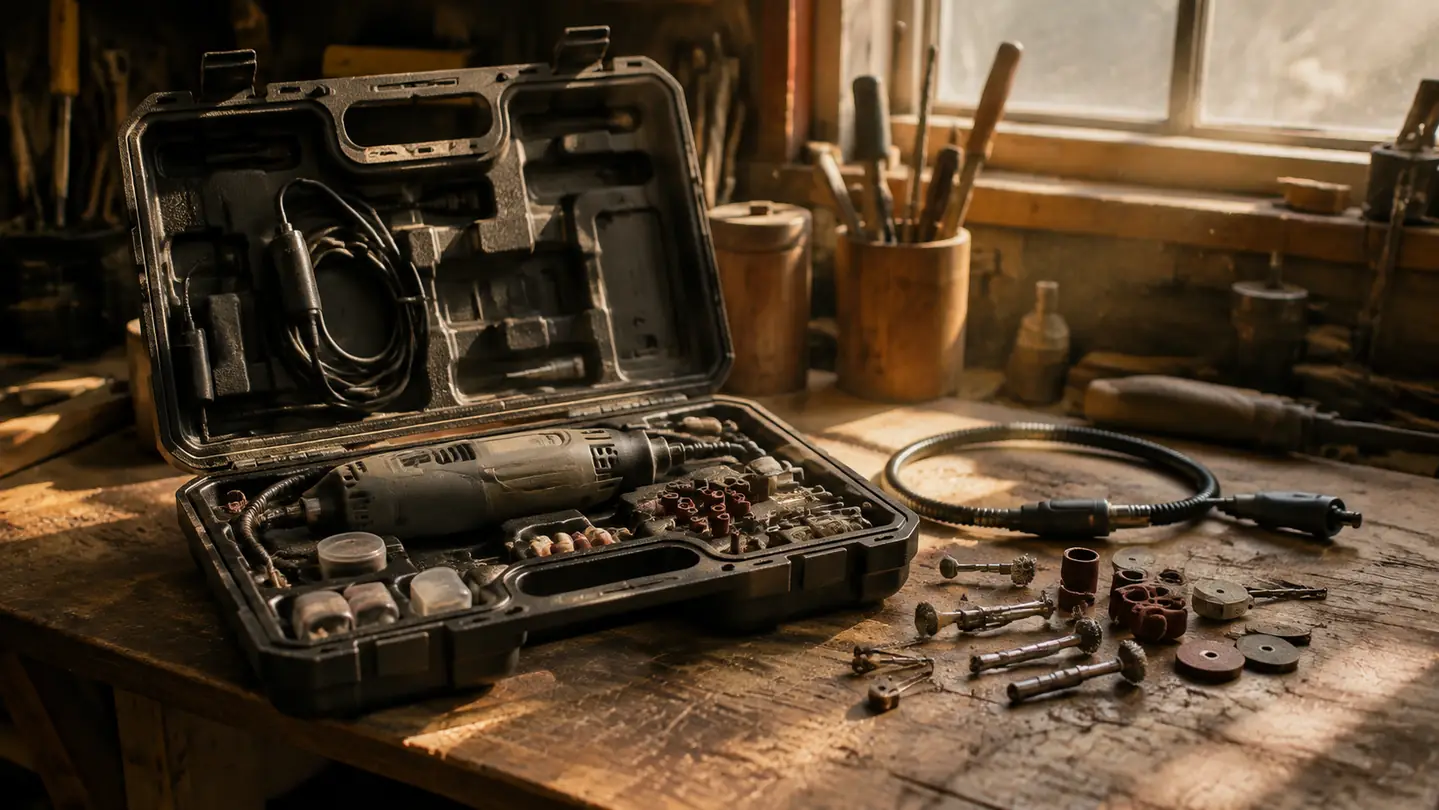
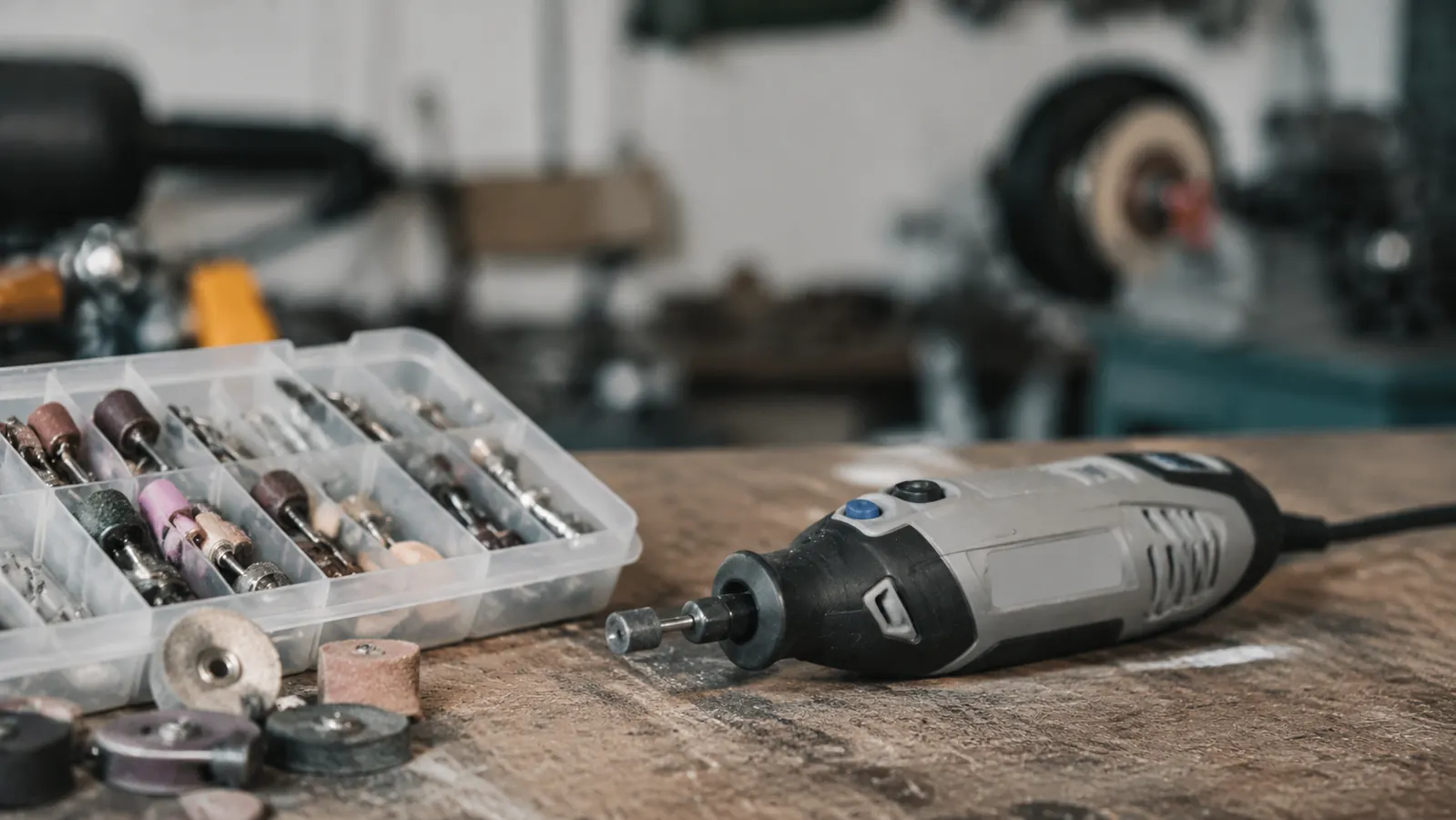
The 4300-5/40 variant is the kit, five attachments and forty accessories in a plastic case the size of a small briefcase. Before I bought it I assumed forty pieces meant forty useful things. Reality: you will use maybe ten of them with any regularity, and the rest sit in the molded slots gathering sawdust. That is not a complaint about value, because the kit still costs less per tool than buying the handful of bits you actually need separately. It is just setting your expectation straight.
Here is what I actually reach for: the cut-off discs and their little arbor mandrel, the sanding drum and bands, the grinding stone, the polishing wheel and compound, and the engraving cutter for the glass. Those five cover ninety percent of my work. The drill bits are useless flimsy things, the brush attachments are fine for light cleaning but not much more, and the storage case, while organized, is awkward to carry into a tight jobsite. You will likely want to keep your everyday bits in a small tray on the bench and leave the bulk of the case in the cabinet.
The five attachments are the shaping guide, the shield, the cutoff guide, the line and circle cutter, and the detailer's grip. The ones that earn their keep for me are the shield (it keeps the worst of the dust and sparks off your hand) and the shaping guide for grinding down to a line. The flexible shaft itself is sold separately and is worth buying in time; it does not come in this kit, and it converts the tool into a precise little pendant for detail work. Put it on your list when the budget allows.
What I Liked
- Wide 5,000 to 35,000 RPM range handles everything from fine engraving to cutting steel
- EZ Twist nose cap is genuinely faster for bit changes than the old chuck key style
- Integrated LED throws a focused beam right on the work area
- Real Dremel build quality with a company that stands behind parts and accessories
- Forty-piece kit is still economical versus buying the few bits you actually use separately
- Quiet enough and well balanced for long sessions without hand fatigue
Where It Falls Short
- No on-tool storage for the stamped collet wrench you need when changing shank sizes, which you will lose at least once
- Noticeable runout at the top speed range on certain bits
- Built-in LED is a small pool of light, not a floodlight
- Only a handful of the forty included accessories are ones you will actually use
- Thin bits are easy to seat slightly crooked until you learn the hand-tightening trick
Who This Is For
Buy the Dremel 4300 if you are a homeowner or hobbyist who does a little of everything and wants one tool that handles the breadth. If your project list includes any sharpening, polishing, light cutting, engraving, or detail sanding, this is the tool you will reach for again and again. It is also the right choice if you already know you want to do fine work like engraving or carving, because the variable speed and the accessory ecosystem give you room to grow without buying a second tool. If the price of the kit versus buying bits separately matters to you the way it does to me, the 5/40 version makes straightforward sense.
Who Should Skip It
Skip the 4300 if you have never needed a rotary tool and cannot name the two jobs you would use it for this month. It is a specialized generalist, and a tool that sits in a case is a bad investment even when it is a good tool. If all you need is to grind or cut, a small angle grinder is cheaper and faster for that one job. And if you are a production shop doing fine detail work every single day, you may want a model with a true collet and a second, dedicated chuck rather than the convenience-oriented system here. For the everyday DIYer, none of that applies, and this is the one to buy.
The Straight-Talk Verdict: It Earns Its Place on the Bench
For the breadth of jobs a homeowner actually throws at a rotary tool, the Dremel 4300 is the one to buy, if you go in expecting to keep track of the collet wrench and pick your speeds. See today's price on Amazon and decide.
Amazon Check Today's Price on Amazon →At the end of the day the Dremel 4300 is the most useful rotary tool I have owned, and I say that with its annoyances on the table. It has paid for itself many times over in the sharpening, the brass polishing, the drywall work, and the jobs it let me handle myself instead of calling a contractor. It is not perfect, and no tool worth its price is. Buy it knowing the collet wrench will wander off and that not all forty accessories matter, and you will be as satisfied with it as I am. That is the honest version, and it is the one the five-star photos never show you.
Let me leave you with the test I use on every tool, because it is the one that settles it. Four evenings a month I walk into the shop with a job in mind, usually something I have been putting off, and I ask myself which tool in the drawer is going to make the least fuss about it. The 4300 is the answer more often than any other tool I own. Sharpening, polishing, cutting, engraving, the open drywall box, the seized bolt that needs a clean cut, it handles the breadth that nothing else in my shop does. It is not perfect, and I have told you honestly where it is not, the collet wrench you will lose, the runout at speed, the LED that is a pool and not a flood. None of that changes the verdict. For a homeowner who wants one tool that actually does the wide range of jobs, the 4300 is the one, and fourteen months of use has never once made me wish I had bought something else.