I sharpened lawn mower blades for twenty-five years with a file and a bench grinder, and I defended both to anyone who would listen. Then a project forced my hand: a 1930s brass lamp from my wife's aunt, green with tarnish, that had sat in a box for a decade. A shop quoted me to rewire and polish it. I told my wife I could do it for the price of a rotary tool, and I believed it for about five minutes before I started reading spec sheets. The Dremel 4300-5/40 kit showed up on my bench in early September. Twelve months later, in a project log kept the way I keep a rental ledger, I can tell you exactly what it earned and where the box of forty accessories lies to you.
Be plain about my prejudice before I start. I am the man who reads the one-star reviews first, and a rotary tool is an easy thing to distrust. It looks like a toy next to a cordless drill and vibrates like a phone on a glass table, and no single tool should promise grinding, cutting, carving, sanding, and engraving in the same box. Promise everything and deliver none of it is the usual rule. So I went at this slowly, one job at a time, the way I would test a used truck before buying it.
The Quick Verdict
A year of real projects says the 4300 is the rare do-everything tool that actually does. The motor holds up, the EZ Twist collet system makes bit changes painless, and the cord means no battery sag ever. It earned its shelf space, with two honest flaws I would fix before I bought again.
Amazon Check Today's Price →The Rotary Tool That Paid for Its Box in One Lamp
The brass lamp alone covered what this kit cost me in saved shop labor, and the year that followed only widened the gap. If you are weighing a rotary tool, this is the kit I would put your money on at today's price.
Amazon Check Today's Price on Amazon →How I've Used It: Twelve Months in the Project Log
The ledger opens with that lamp, because it is the kind of job a rotary tool does better than any other tool I own. I stripped the old lacquer with a carbon steel brush at low speed, chased the engraving with a fine brass wheel, and brought the body to a mirror shine with felt bobs and polishing compound. Three evenings of bench time. The shop quote turned into maybe six dollars of compound and a tool I still had when it was over. That is the whole argument for the 4300 in one job.
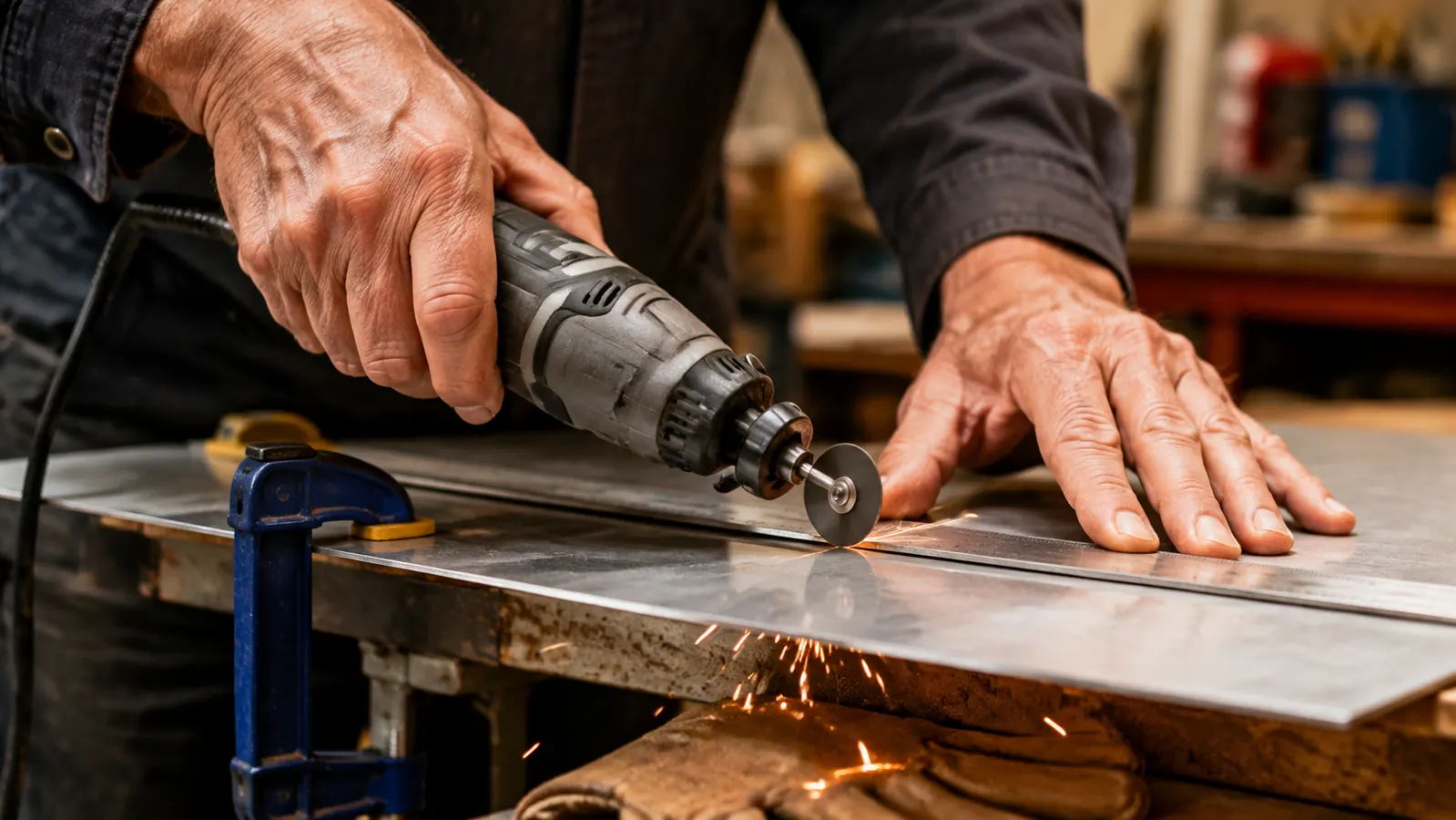
From there the page fills fast. Two mower blade sharpening sessions, spring and fall, where I learned the grinder in my shed was retiring for good. A dozen drywall cutouts for outlet boxes where the spiral cutter shaved the opening inside the pencil line. A rusted gate hinge on the rental that a cutoff wheel freed in under a minute. Copper pipe I had to trim in a crawl space where no saw would swing. And steel nameplates I engraved for my grandsons' bedroom doors, done badly at first and acceptably by the third try.
Then the carving, which keeps me honest about this tool. I took a discarded maple newel post from a reno dumpster, cut it into two pieces, and carved faces into both over the winter. The 4300 did not do that work, I did, but no other tool in my shop can do it at all. A chisel does relief carving in an afternoon. A rotary tool does it in six patient evenings. What it makes possible is the thing you are otherwise not doing.
Why the Motor and EZ Twist System Matter More Than the Accessories
The spec that actually matters is the motor staying strong under load. The 4300 runs a 1.6-amp motor at variable speeds up to 35,000 rpm, which sounds like a lot until you lean a grinding stone into a rusty bolt. Cheap rotary tools bog down the second the bit touches metal, and a motor that bogs at 10,000 rpm is driving a rounded-off bolt, not cutting one. In a full year I have never once felt this motor give way under me. I have stalled the spindle by jamming a bit sideways, which any rotary tool will do, but never by working it the way it is meant to be worked.
The second thing worth the money is the EZ Twist nose cap. On older Dremels, changing a collet meant hunting for the flat wrench that lives in the bottom of the case, holding two wrenches together in the dark, and trying not to drop a 1.5 mm collet into the sawdust. On the 4300 you pinch the nose cap, twist, and the bit comes free with a quarter turn, without digging the flat wrench out of the case. That sounds small until you have changed bits ten times in one evening, which is exactly what a carving session does.
The LED light around the nose deserves a line too, because it is the difference between seeing the cut and guessing at it. My shop's aging overhead fluorescents throw shadows exactly where a work head sits. The ring light on the 4300 lights the work area, not the wall behind it, and after dark on the porch it is the whole reason the bit ends up where I aimed it.
The Five Attachments: What Actually Earns Its Keep
The kit ships with five attachments and a pile of accessories, and my project log sorted them into tiers fast. The best of the bunch is not even in the box. The flex shaft, which I bought separately early on, is the clear winner. It is a coiled cable with a separate hand piece, and it turns the whole tool into a pencil. For fine engraving, for working inside the lamp shade, for the tight spot behind the toilet flange, the flex shaft does work the main body cannot reach, and it cuts the weight to nearly nothing in your hand. Even bought on its own, the flex shaft alone would justify what it costs.
Of the five that do come in the box, the line and circle cutter takes the top tier. It is genuinely clever, a little pivoting arm that scribes perfect circles for cabinet knobs and hinge mortises, and I have used it more than I expected. The cutoff guide is the clear plastic base that steadies the tool for straight cuts, and it works, but it is the attachment I reach for least, because my hand does the same job after the third practice cut.
The shield, the shaping guide, and the detailer's grip round out the box, and I will be honest: the detailer's grip has stayed in its slot. What it does well is fine pencil-grip control for inlay work, and I do none of it. The shield I have used twice, for grinding jobs that spray sparks, and it does its one job without complaint. The shaping guide is the one I keep reaching for, because grinding down to a line is most of what I ask this tool to do. None of the five attachments is junk. Some will just live in the case for a given owner, and you will not know which until your projects vote.
The 40 Accessories: What the Marketing Photo Doesn't Tell You
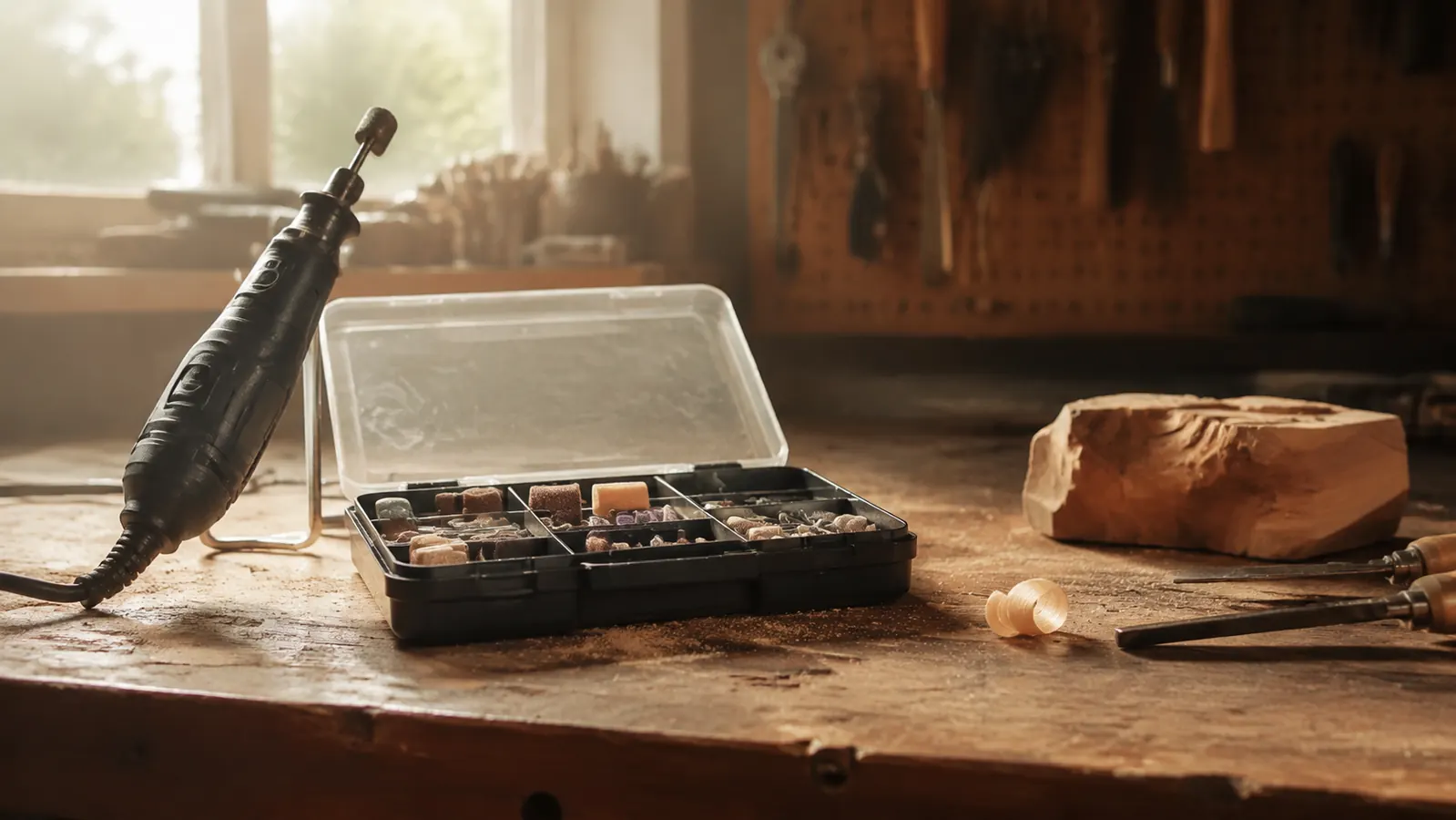
Here is where I earn my keep as a reviewer. The box says forty accessories, and it delivers forty accessories. What it should say is twenty accessories twice, because the packaging breaks things into duplicates to hit the number. You get sanding bands in a sensible range but multiples of the same grit, grinding stones that are variations on a theme, and a pair of metal brushes that differ only in width. The set is not dishonest, it is just front-loaded with duplicates. Count what you actually got before you plan around it.
The genuinely useful standouts, from the log: the 402 mandrel with its sanding bands, the felt bobs and polishing compound for metal, the spiral cutter for drywall, the fiberglass cutoff wheels for rusted fasteners, and the carbide carving bits I burned through before I bought my own spares. Those five earn their keep. The engraving bits are fine and dull fast, and the small-diameter grinding stones are for jewelry, not for anything I have done yet.
Plan a small accessory budget for the first six months. The included cutting wheels and sanding bands are consumables, and the kit's real weakness is that it does not include spares of the two things you will burn through. A pack of Dremel cutting wheels and a sleeve of sanding bands at today's price keeps the tool working while the kit accessories go to their graves.
A shop quote for a brass lamp turned into six dollars of compound and a tool I still reach for eleven months later.

Corded Versus Cordless: Why I'm Glad This One Plugs In
Dremel makes cordless versions, and the cordless crowd will tell you freedom from the wall is everything. After a year of the corded 4300, I am the other voice on that argument. A rotary tool is a fine-work tool. It runs for minutes, not hours, and it spends most of its life free-spinning between actual cuts. That is exactly the use pattern where a battery pays a tax and gives nothing back. Every charge is a countdown to a recharge, and my worst moments with cordless tools are always the ones that happen at 11:30 on a Saturday when the battery died.
The corded motor also runs at full strength until the breaker trips, with no voltage sag as the charge drops. On the polish job that made the lamp shine, the last pass was as fast as the first, and that consistency is what a mirror finish depends on. If I were restoring furniture professionally on a cart, I might want the cordless model for the freedom. For a workshop bench and the occasional extension cord to the porch, the corded 4300 is the better tool and the better price.
Where the 4300 Falls Short, Honestly
No tool gets a perfect ledger, and I keep the Dremel's debits on the same page as its credits. First, the four-foot cord is shorter than I like. Around my bench, with the case on the shelf and the outlet on the back wall, the tool is fine. Out at a job site without an extension cord it turns into a frustration. Buy one extension cord with the kit and this flaw disappears, but it is a real flaw until you do.
Second, that accessory case. It is the standard Dremel plastic case, and it is a marvel of worst-case packaging. Each accessory lives in its own molded slot, which looks organized until you need the mandrel buried under the sanding drums, at which point you are lifting tray dividers in the middle of a job. Ten minutes of reorganization, or a small parts organizer, fixes it, and I say that because it is fixable, not because it is fine.
Third, the honest limits of a rotary tool itself, which no kit can fix. It is a fine-work tool, not a heavy one. It will trim copper, but it will not cut through schedule-40 pipe in one pass. It will sharpen a mower blade, but it will not resurface one. The people who hate rotary tools are almost always the people who tried to make one do a grinder's job. Keep the tool inside its lane and it will never let you down.
What I Liked
- Strong 1.6-amp motor that holds speed under load, no battery sag over a long project
- EZ Twist collet system means bit changes with a pinch and a twist, without hunting for the flat wrench
- The flex shaft attachment, bought separately, is worth it for fine and difficult-reach work
- LED ring light lights the actual work area and helps in dark corners
- Corded and consistent, with a price that lets the kit earn its keep on one or two jobs
Where It Falls Short
- The '40 accessories' count is padded with near-duplicates, and consumables like cutoff wheels come with no spares
- Short cord means an extension cord is a required add-on for most jobs
- The molded case buries the bits you need during a job
- Not a heavy tool; it can't do a grinder's work and this review stops short of pretending it can
Who This Is For
This is for the homeowner who has said, at least once, that a shop bill is an insult. The person who sharpens their own blade, polishes their own brass, cuts their own outlet holes, and would rather spend an evening learning a tool than an hour paying a professional. If you restore furniture, clean up cast iron, or have ever looked at a rusted fastener and reached for a hacksaw because nothing else fit, the 4300 is worth a real look. And if you travel like I do and keep a small kit for rental maintenance, the whole thing rides in a case the size of a hardcover book.
Who Should Skip It
Be honest with yourself before you buy, because I have read the reviews from the people who never should have. If your entire tool life is framing and drywall and the finest work you do is measuring twice, this is a specialized tool that will sit in its case, and a cheaper kit with a single attachment would serve you as well. If you want it specifically for heavy grinding, buy an angle grinder instead. And if you refuse to carry a cord, the cordless Dremel models are the honest answer, you just lose the consistency and the price advantage. Spend the money on the tool that matches the work.
Twelve Months In, It's Still On the Bench, Not In the Drawer
The lamp paid for it, and the mower blade, the hinge, and the nameplates have paid for the accessories since. If your projects sound like mine, check today's price on the 4300-5/40 before you decide. If they do not, the list above tells you exactly what you actually need, and that is worth more than any sale.
Amazon Check Today's Price on Amazon →