
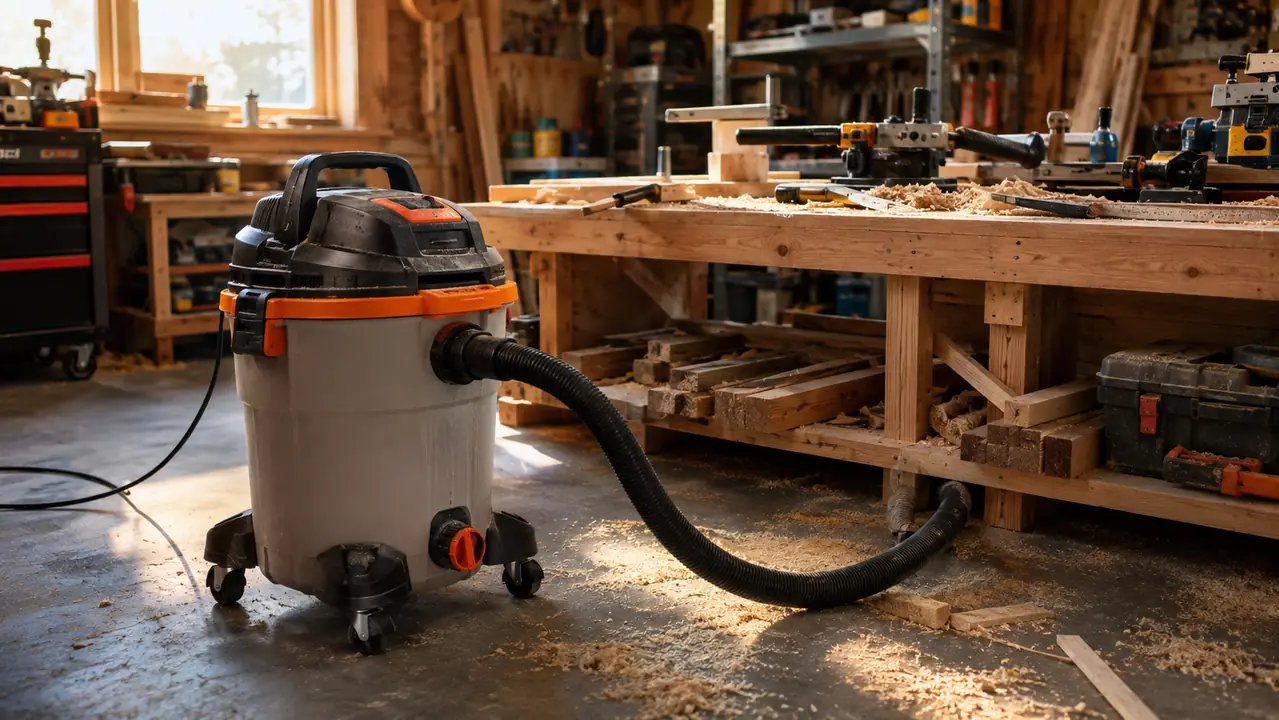
Every shop vac gets reviewed the same way: someone empties a bucket of water into a pan, turns the thing on, and declares it a miracle because it picked the water up. You will not read that review here. I own a rental property and a workshop, and my Stanley SL18116P has spent twenty-four months doing the jobs that actually wreck a vacuum. It has sucked up a gallon of standing water after a water heater let go, a winter of sawdust and drywall dust, a pile of roofing nails, and enough mouse droppings behind the shed that I stopped counting. It still runs. It also has real, honest flaws that almost no review tells you about, and if you are deciding between this and a smaller cordless vac, those flaws matter. This is the unvarnished version.
The Quick Verdict
A genuinely reliable workhorse that will outlive most of what you plug it into, provided you never need to carry it far, you can live with the noise, and you learn to work around a stiff winter hose.
Amazon Check Today's Price →The honest truth is it just works, month after month. See the Stanley 6-gallon vac at today's price.
After two years and a flooded basement, mine has never needed a repair and keeps pulling sawdust and water. If you want a wet/dry vac you can beat on without thinking, this is the one I keep reaching for.
Amazon Check Today's Price on Amazon →How I've Used It
I did not set out to stress-test this vacuum. I bought it to do the ordinary jobs a property owner has, and the ordinary jobs turned out to be worse than the marketing ever admits. In the last year alone this machine has: cleaned up a bathroom reno that left the guest room floor under half an inch of drywall dust; picked up a basement flood after the water heater relief valve failed on a Friday night; sucked up glass, plaster, and screws after a shelving unit came off the wall; and spent every fall pulling leaves and grit out of the eaves troughs I could reach. That is a pile of cleanup I would have paid for if I had hired it out, on a tool that sits near the workbench when it is not saving me.
The 4-horsepower motor is a wet/dry vac spec sheet, not a performance promise, so I do not want to oversell it. Suction is strong for a 6-gallon machine and it stays strong because the motor is in the top half and the tank underneath. But it is not a shop-class industrial vac, and if you expect the kind of pull a 16-gallon unit gives you, you will be disappointed. For my money the honest trade-off is fine: I have never once needed more suction than this gives for the jobs a home actually produces.
What sold me, and what the reviews understate, is the 6-gallon size itself. It is big enough to finish a real basement puddle in one pass without emptying constantly, yet small enough that it wedges under the shelf in the garage. I have owned the bigger 16-gallon monsters and they sit in the corner because nobody wants to drag them up a flight of stairs. This one, I actually use.
What Arrives in the Box and First Impressions
Assembly took me about ten minutes, most of it snapping the casters into the bottom of the tank and threading the hose onto the inlet. The box holds the main unit, the hose, two rigid wands, a wide pickup nozzle, a crevice tool, the pleated cartridge filter, the foam wet filter, and an accessory bag for dry-only vacuuming. Notice what is missing, because it matters: there is no blower nozzle in the box, no car-cleaning brushes, no narrow floor tool. If your jobs need those, and a lot of mine do, budget for a couple of accessories separately and they are cheap.
My first impression, before I ever pulled a trigger, was the weight and the handle. At roughly twenty-five pounds this is not a bagless lightweight, but the handle sits high enough that I can lug it up the basement steps without thinking twice, and the wheels pull the empty weight for you on flat ground. The moment I switched it on I knew two things for certain: the suction was real, and the noise was real. I am not going to sugarcoat that second one, and the fact that the marketing photos all show someone calmly vacuuming with a pleasant expression tells you more than the spec sheet does.
The Things Nobody Posts
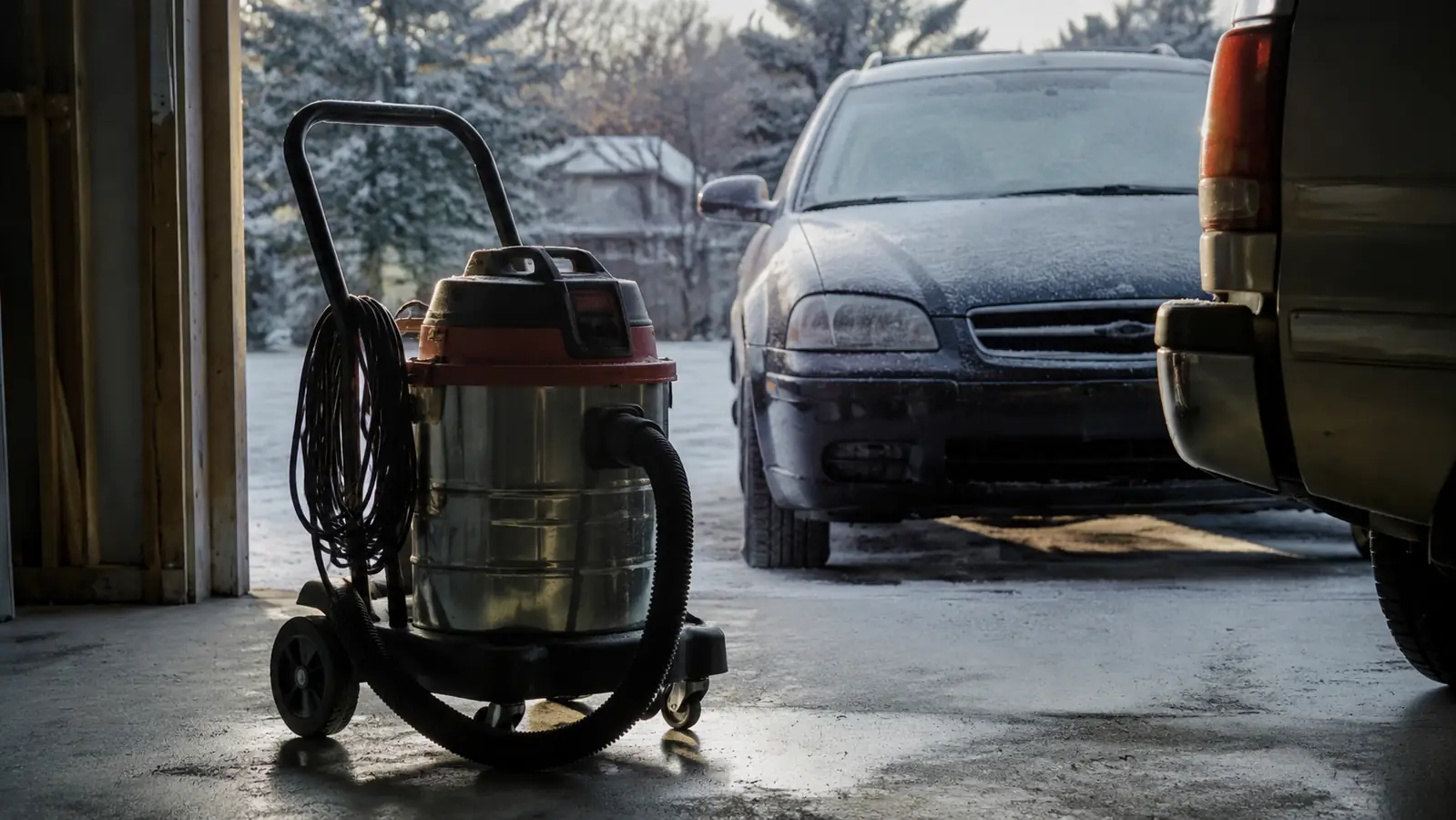
Let me start with the honest negatives, because they are the reason this is not a five-star everything review. First, the hose. In summer it is flexible and pleasant to use. Below about 40 degrees, out in the garage or on the porch, it stiffens into something closer to rigid PVC pipe, and it fights you the whole job. It does not crack, and two winters in it has not, but you will wrestle it. If you plan on doing most of your vacuuming in a heated space you will never notice. I do mine in a cold Michigan garage half the year, so I notice every single time.
Second, the noise. This is not a quiet vacuum. It is a corded shop vac doing real work, and it sounds like it, the kind of sound that means you turn it off if you want to hold a conversation or hear the doorbell. The spec sheet calls out the decibel level and it is not shy. If quiet cleanup matters, look at a cordless stick vac for the light chores and keep this one for the emergencies.
The filter is the part you will think about every single month, because the instant it loads up with fine drywall dust, your suction drops by half and you think the motor died. It did not die. The filter is just full.
Third, and this is the one nobody tells you, is the filter. This unit ships with the standard pleated cartridge filter, and for wet pickup you must remove the paper filter or you will gum it up. For dry pickup the filter clogs fast on anything fine, drywall dust in particular, and suction falls off noticeably until you tap it clean. That is normal for the cartridge, and it is worth knowing before you blame the motor. Buy a spare filter early and keep it in the kit. It is the cheapest insurance on the whole tool.
Fourth, the accessories. What comes in the box is honest and basic: the hose, a couple of wands, a wide pickup nozzle, a crevice tool, and the optional bag for dry-only work. Do not buy it expecting a car-cleaning brush kit or a blower nozzle in the box, because neither ships with it. The blower port does what blower ports do, and a foam arrowhead filter slips in for wet use, but you will be buying a couple of upgrades if your jobs look like mine.
How It Handles the Jobs That Matter
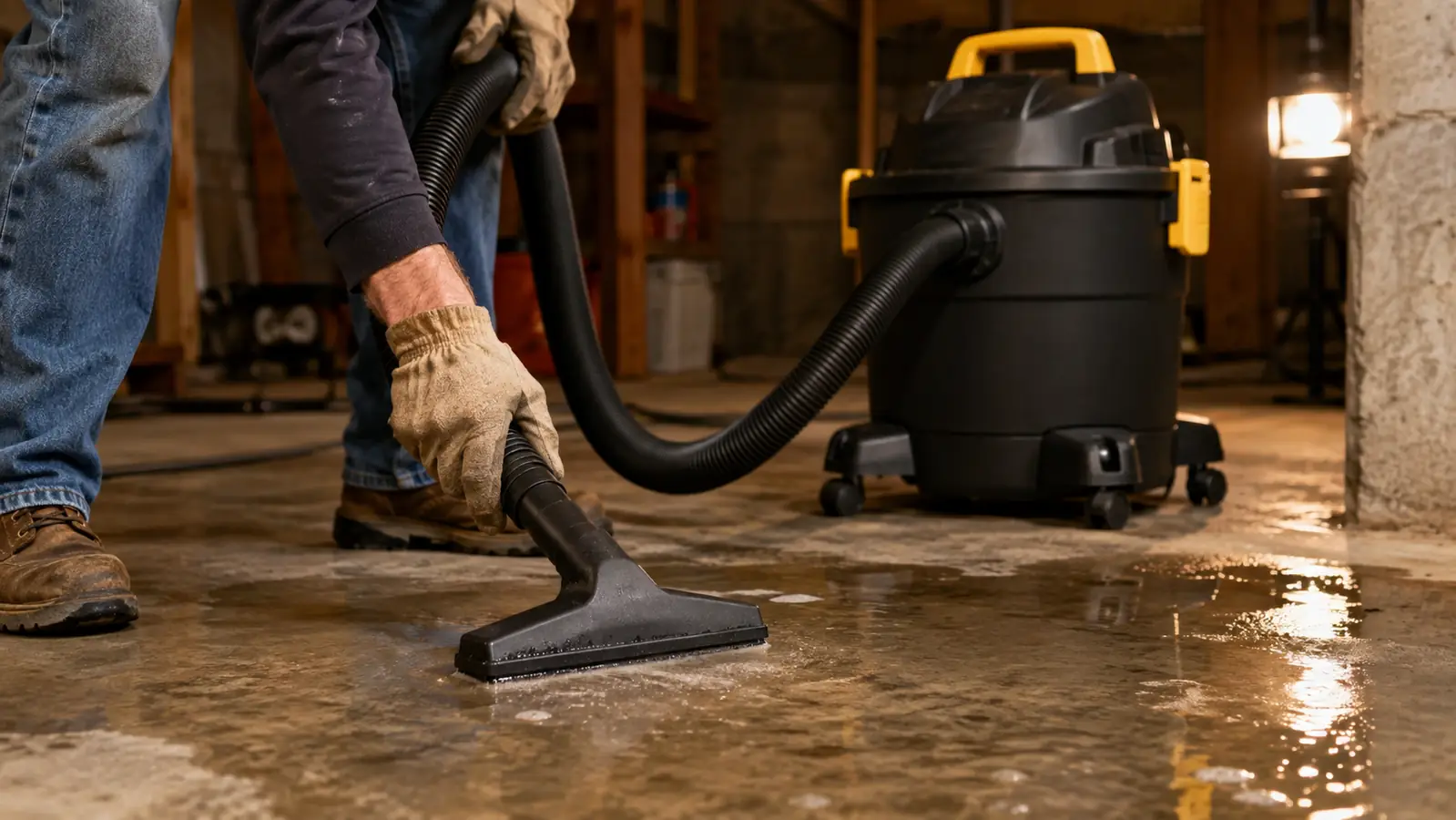
The thing that most impressed me, and the test most reviewers skip, is wet pickup at volume. When the water heater valve failed and put about three gallons on the basement floor, I swapped out the paper filter, snapped on the foam, and the Stanley pulled it dry in a few minutes with the nozzle wide open. It did not choke, did not trip its breaker, did not spew water out of the exhaust. The float shut it off cleanly at the top of the tank before any water touched the motor. That single feature, a float that actually works, is worth more than any marketing claim on the box.
For dry jobs it has been just as dependable. Latex paint dust, sawdust, roofing nails, sand, and gravel all end up in the tank, and the wide pickup nozzle keeps a clean path so nothing plugs. One habit I picked up: I keep a 2-inch gap of hose slack and sweep the nozzle in a slow overlap, the way you would mow a lawn, and it cuts pickup time roughly in half. The tank empties by tipping and pouring, and the drain plug at the bottom makes the liquids dump without lifting the whole machine, which my mid-60s back genuinely appreciates.
One more honest note about the blower port. It works, and it is handy for clearing sawdust off the workbench or blowing out the garage. But it turns the hose into a stiff pile-driver in the cold for the same reason the suction hose does, and it is loud enough that the neighbors know when you are using it. Fine for me. Worth knowing for you.
The Long-Term Cost of Owning It
Here is where the investor in me does the real math, because a tool only counts as a bargain if it does not quietly eat you alive in upkeep. Over two years this machine has cost me almost nothing beyond the purchase: one replacement pleated filter, maybe a dozen dollars, one cheap roll of accessory bags I use for the finest dust so the paper filter lasts longer, and electricity that is negligible on a motor this size. No repairs, no parts, no service calls. Compare that with the cordless route, where the battery is the most expensive part of the machine and will need replacing inside that same window at a cost that often approaches half the tool. When I weigh buying once against buying twice, that math is what makes corded win for my kind of work.
I also factor in the margin it has already earned. A water heater leak that would have meant a wet-vac rental and half a day is now an hour with a machine I already own. A renovation clean-up that would have had me hiring a hand with a truck is an evening alone. Nobody buys a shop vac to make money off the box, but this one has paid for its own replaceable filters many times over in jobs I did not have to hand to anyone else. That is the honest definition of a tool earning its place: it does not sit in the corner, it quietly makes the next job cheaper.
What I Liked
- Small enough to carry and store, big enough to finish a real job without constant emptying
- Reasonable suction on dry dust and genuinely strong wet pickup, with a float that actually shuts off
- Drain plug for pouring out liquids without lifting the whole tank
- Motor on top, tank below, so nothing wet ever reaches the motor
- Over two years of abuse and zero repairs, with cheap consumables
Where It Falls Short
- Hose turns stiff and fights you in winter temperatures
- Genuinely loud, both as a vac and as a blower
- Pleated filter clogs fast on fine drywall dust and suction falls off until you tap it clean
- Basic accessory kit, no blower nozzle or car brushes included
- Not enough static pull for the heaviest shop-class work
What Holds Up and What Wears
After twenty-four months the honest scorecard is mostly good. The motor shows no sign of fading, the casters roll freely, the tank has no cracks or leaks despite being tipped and dragged, and the seal between the top and bottom halves still holds. The plastic is thick enough that I have dropped it off the back of the tailgate twice without a crack. That is the durability I care about, because the whole reason I bought a corded machine instead of a cordless one is that a corded motor has fewer expensive parts to fail, and it did not just hold up in the ads, it held up here.
What wears is the consumable side, which is normal and cheap. The pleated cartridge filter picks up fine dust and needs tapping or blowing out, and I have worn out one in the two years. The foam wet filter is still going. The hose has held up, stiff in winter but intact, and the wands and nozzles have lost none of their fit. None of that should scare you, because none of it is the expensive part of the machine. The motor and tank are the heart, and both are sound.
Where the Cordless Argument Falls Apart
Here is the honest comparison that every review tip-toes around. A lot of people are tempted by a cordless wet/dry vac because it is quiet and you can carry it up a ladder. I own one too, and it is fine for a small spill on a hardwood floor. But the moment you try to do real cleanup, a flooded basement, a sheetrock reno, a truck bed full of leaves, a cordless unit runs out of battery mid-tank and you are left holding a partial cleanup. The Stanley is corded. It never runs out, it never fades as the tank fills, and the motor is a genuine 4-horsepower motor instead of a battery-sized one. For the emergencies this machine exists for, cordless is the wrong tool and the marketing knows it.
That is not me knocking cordless machines. It is honest talk about where each one belongs. If your wet/dry vacuum spends its life picking up small household spills and the occasional dirty shop floor, a battery machine is simpler and quieter. If it has to save your basement, clean a workshop, or survive a renovation, the cord is a feature, not a flaw. I keep both, and the Stanley does the heavy work every time.
Who This Is For
Buy the Stanley SL18116P if your vacuum is going to live somewhere accessible, a garage, a basement, a shop, and do real work. It is a great first wet/dry vac for a new homeowner, an honest second unit for a shop that already has a specialty vacuum, and exactly the right thing for a rental property owner who needs one machine to handle whatever the tenants leave behind. If you want a tool that will still be running in five years, takes a beating without complaining, and costs a fair price for what it delivers, this is it.
Who Should Skip It
Skip it if you need quiet, if your cleanup is all light dry spills on hard floors, or if you have no place to park a 6-gallon machine and would rather have something that fits under a desk. Skip it if you vacuum mostly in cold unheated garages and hate wrestling a stiff hose, though I will note the hose has never failed. And skip it if you expect pro-grade static suction and a full accessory kit, because this is an honest home and property workhorse, not a one-tool-does-everything contraption.
If a flooded floor or a monthly pile of sawdust is in your future, stop renting cleanup and own it.
Two years in, mine has earned its space by the workbench and never needed a repair. If that is the kind of dependability you want, check the current price and put one in before you need it.
Amazon Check Today's Price on Amazon →